Book: Candide
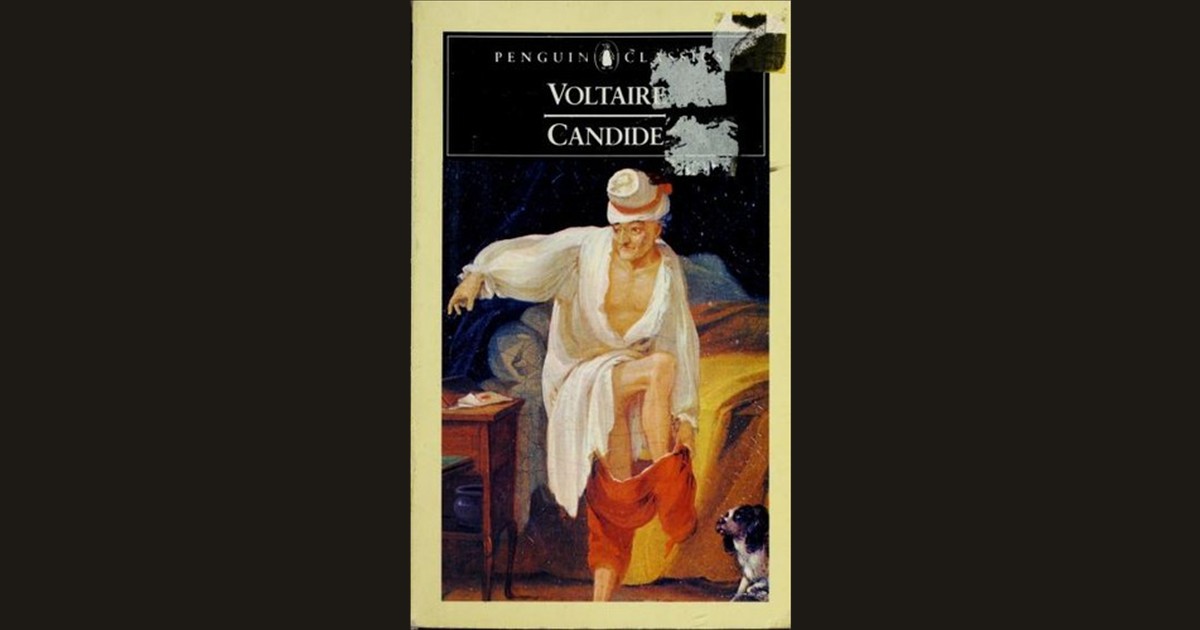
Overview
Title: Candide, or Optimism
Author: Voltaire (François-Marie Arouet)
Published: 1759
Genre: Philosophical satire / Novella
Pages: ~144 (varies by edition/translation)
Date Read: 2026-03-07
Rating: 9 / 10
Description
Candide, or Optimism (Candide, ou l’Optimisme) is a novella by the French Enlightenment writer Voltaire, published in 1759. It is considered one of the great works of Western literature and a masterpiece of satirical writing. The story follows the naïve young Candide, who has been raised to believe, following the philosophy of his tutor Dr. Pangloss, that he lives in “the best of all possible worlds” — a direct parody of the optimistic philosophy of Gottfried Wilhelm Leibniz.
The novella sends Candide through a series of catastrophes — wars, earthquakes, inquisitions, slavery, and shipwrecks — each one a pointed satirical jab at philosophical optimism, religious hypocrisy, political corruption, and human cruelty. Despite its dark subject matter, Candide is wickedly funny and moves at a breakneck pace.
The novella ends with the famous line:
“We must cultivate our garden.”
— Voltaire, Candide (1759), Chapter 30 (public domain)
My Notes
My spouse has been quoting this book and referring to it in a loving way since the day we met. I finally decided to read it and see what all the fuss is about. Of course most people have heard the phrase “best of all possible worlds” in various contexts, such as a unfortunate outcome, even a tragedy. This book brings the idea that we should be rosy-glassed hopeful that things will just turn out alright no matter the circumstances to a whole new metaphorical meaning.
It does not remove the attitude that hope is a good thing, but does bring to mind another great work, Meditations by Marcus Aurelius. The combination of these two works is interesting, one side advocating in jest for one to be wholly hopeful that all is as it should be in ‘the best of possible worlds’ and the other having a more pragmatic existentially ‘stoic’ approach to reality as it truly is.
Although the above may make this work seem to be ‘heavy’ or boring in nature, it is definitely not. I found it to be delightfully comedic in nature. Candide continues to cling to the teachings of his old “master” Pangloss as a way all people should look at the outcomes in life. This despite life dealing him and his fellow travelers with the most egregious of happenings. This is definitely an entertainment to see how Candide will continually expect that things will turn out for the better despite all evidence to the contrary.
The most important part I feel is the point made that the systems in place throughout the book are absurdly bent on systems that justify cruelty. This is something we can look out for in our own lives and try to effect change. Systems that arbitrarily punish people for reasons that are not of their own fault are especially glaring in this novel.
Throughout the book, Candide clings to the teachings of naive hope, but it slowly erodes to the end where he is left determined to abandon Pangloss’s teaching for a new practical one where action is needed; not waiting for things to turn out ok, but taking part in making it so. Core message… don’t be passive in your life… make changes for the betterment of all.
- What drew you to read an 18th-century French satire in 2025/2026?
- The consistent mentions of my partner, especially how it relates to unjust systems in place in our time.
- Did the humour land for you, or did some of it feel dated?
- Laughed out loud. Recanted the parts to my wife several times.
- How did Voltaire’s pessimism about optimism strike you — particularly given what you’ve navigated personally this year?
- It is interesting to hear that we have not changed much in our nature of government and societal approach to unfortunate events in macro. I sardonically enjoyed the humor in Voltaire daring to defy the forces in his own time, then at great risk to himself.
- What do you think Voltaire meant by “we must cultivate our garden”?
- I think this is a rejection of the systems in Voltaire’s own time that glossed over (did Pangloss come from that?) the suffering of others. It seems this is a call to take action to fix the ideals that things are just as they should be, and we can’t change them. Not to hide behind this philosophy of allowing cruelty because ‘that’s how it is’.
Quotes
Location: 1,182
“It is another kind of folly,” said Martin. “You know that these two nations are at war for a few acres of snow in Canada, and that they spend over this beautiful war much more than Canada is worth.
Location: 1,567
man was born to live either in a state of distracting inquietude or of lethargic disgust.