Book: How We Got to Now
Overview
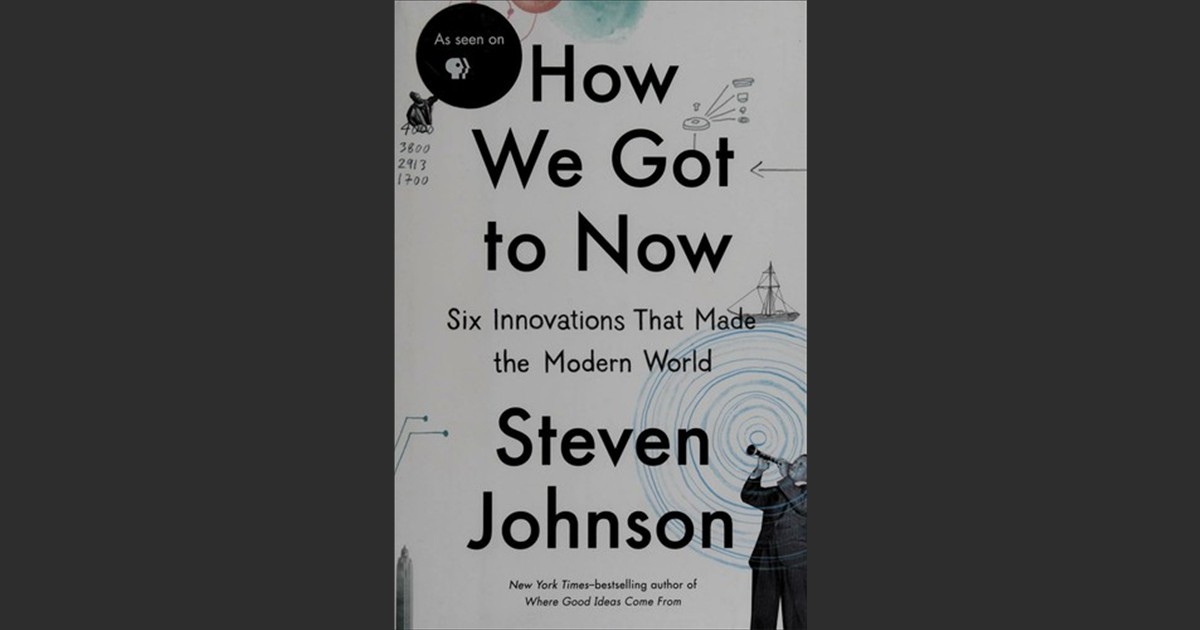
Title: How We Got to Now: Six Innovations That Made the Modern World
Author: Steven Johnson
Published: 2014
Genre: Popular science / History of technology
Pages: ~293
Date Read: 2026-02-14
Rating: 9 / 10
Description
How We Got to Now by Steven Johnson examines how six fundamental innovations — glass, cold, sound, clean, time, and light — shaped the modern world in unexpected and far-reaching ways. Johnson’s central concept is the “hummingbird effect”: just as flowers evolved to attract hummingbirds, and hummingbirds in turn evolved to feed on flowers, innovations in one domain trigger cascading changes in entirely unrelated fields.
Johnson traces surprising chains of causation: how the invention of the printing press led to the widespread use of eyeglasses, which in turn sparked optical research that eventually produced the microscope and telescope. The book was also adapted into a PBS/BBC television documentary series of the same name.
“The strange and wonderful thing about the hummingbird effect is that the triggering innovation doesn’t have to resemble the effect it ultimately causes.”
— Steven Johnson, How We Got to Now (2014)
My Notes
This is one of those awesome books that distill the history of science down to a nice neat story that flows beautifully and shows how all our current (and likely future) technologies evolved from a set of previous usually market driven discoveries of the past. I’ve read a few books that are similar in nature, such as Bill Bryson’s A Short History of Nearly Everything where you get a story of how things lead from one discovery to the next building on the previous to evolve the science. This was one of my favorite books of the year.
Sand! It’s all sand! Seems like silica is the heart of the historical bases of technology today. It is amazing the ripples that are caused by simple things like the need for glasses to read with.
- Which of the six innovations surprised you most in terms of its downstream effects?
- It is all about sand. Sand made glass, books make people want glasses, glasses make lenses more evolved, which makes microscopes and telescopes which make the possibilities of micro and macro discovery possible.
- Did any chain of causation make you look differently at something in your daily life or work?
- The idea of a culmination of discoveries is quite interesting. It seems like a set of things always needs to happen to lead to new bigger discovery, however the way in which they happen nearly make them inevitable in the path they take to combine.
- As an engineer, did the “hummingbird effect” resonate with how you’ve seen technology develop?
- Certainly! In my own life I’ve been fortunate to see the emergence of many technologies. Internet was not a thing till I was a teen, cellphones not till I was leaving College, now the AI phase has become the next thing… I am interested to see all the connections between how these things push each other to evolve to the next phase.
- Were there chapters that dragged, or ones you’d recommend skipping to first?
- None… this was such a nerdy page turner.
Quotes
Location: 2,250
New York: Adapting the Brush Electric Light to the Illumination of the Streets, a Scene Near the Fifth Avenue Hotel. Why should we care whether Edison invented the lightbulb as a lone genius or as part of a wider network? For starters, if the invention of the lightbulb is going to be a canonical story of how new technologies come into being, we might as well tell an accurate story. But it’s more than just a matter of getting the facts right, because there are social and political implications to these kinds of stories. We know that one key driver of progress and standards of living is technological innovation. We know that we want to encourage the trends that took us from ten minutes of artificial light on one hour’s wage to three hundred days. If we think that innovation comes from a lone genius inventing a new technology from scratch, that model naturally steers us toward certain policy decisions, like stronger patent protection. But if we think that innovation comes out of collaborative networks, then we want to support different policies and organizational forms: less rigid patent laws, open standards, employee participation in stock plans, cross-disciplinary connections. The lightbulb shines light on more than just our bedside reading; it helps us see more clearly the way new ideas come into being, and how to cultivate them as a society.